You can't call people to you
Picture a path running across open country. A group is walking it, heads down, making good time. They have a map, they have a destination, and every step takes them closer to it.
Off to one side, up on a rise, somebody is standing still and shouting. Not that way. Come and look at this. You need to see what I'm seeing. They are waving their arms, and they are right about something, because from up there you can see things you cannot see from the path.
The group hears something. A few of them look up and wave back, and some of them shout back: stay on the path, there's a plan. Then they keep walking. The person on the rise shouts louder, and nobody moves. At the end of the day both sides go home convinced the other one was not listening, and both of them are correct.
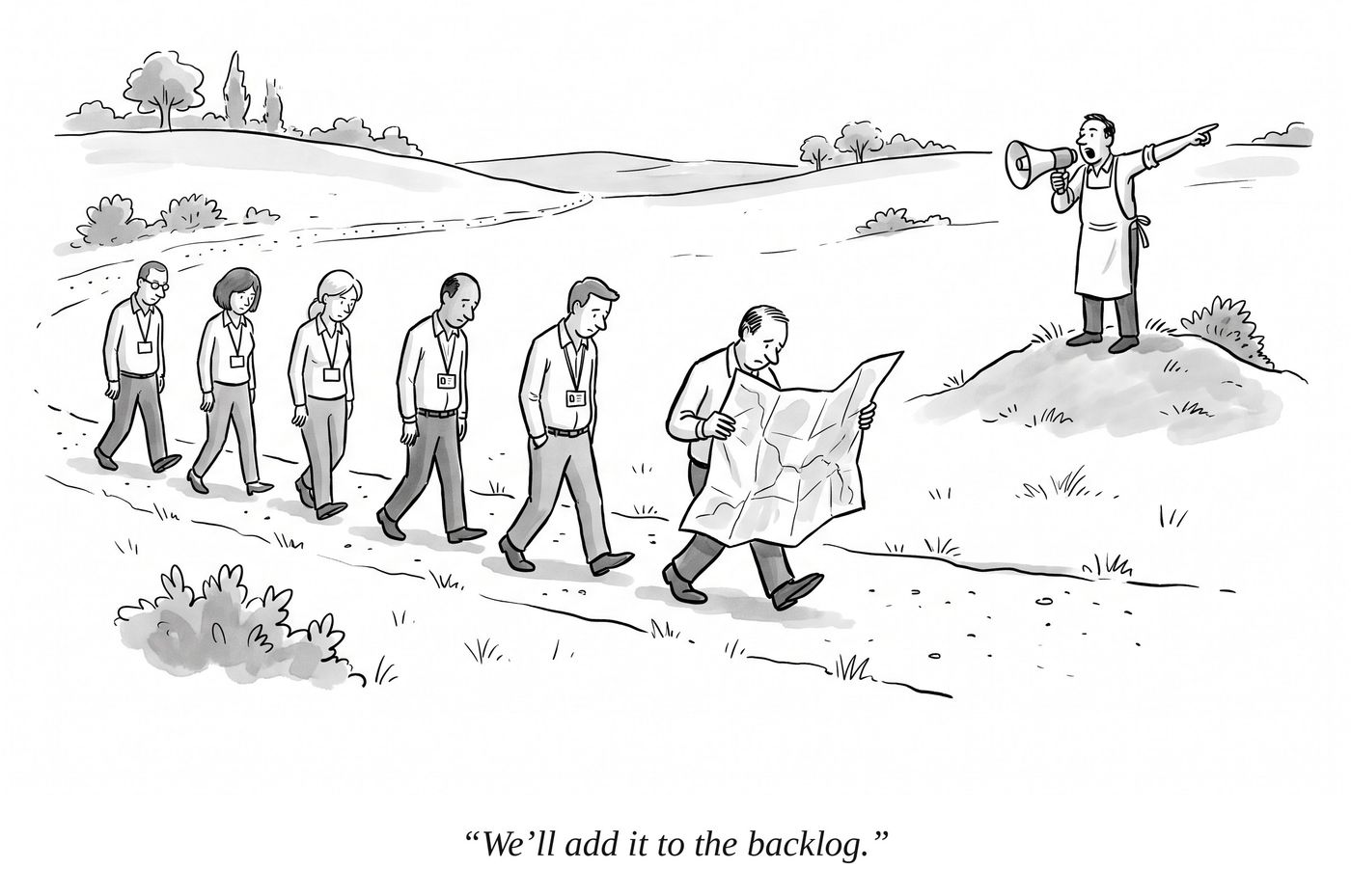
I have been both of those people, and I suspect most people who have built a product for enterprise customers have too. The group on the path is the product team, with its roadmap, its velocity and its core product. The person on the rise is the customer, or a stakeholder, or a brand team with a launch date and a board to answer to. Each of them is standing in one place, calling the other one over, and neither of them is going anywhere.
When El Pollo Loco came to us, that was where they felt they were. Constantly standing apart, shouting at us to go another way or to come and see what they were seeing. And inside QikServe the instinct was to shout back. Stay on the path. One core product, no branches, no custom builds.
For years before that, QikServe had sold its most valuable thing without putting it on the price list. Enterprise kiosk deployments came with brand consultation attached: translating brand guidelines into working systems, advising operators on menu structure and attract screen strategy, carrying estates through go-live. We delivered professional services and treated them as an implementation detail, so every deal absorbed a little more design work, and none of it had a cost, a scope or a name.
El Pollo Loco changed that. It was a huge, live project, paid for as a long-term engagement, and it was the launch of professional product and design services at QikServe. Design drove the roadmap, not product. Design ran engineering, accounts, implementation, design and product management. It was our job to get what El Pollo Loco needed out of the core product.
The constraint was real on both sides. QikServe did not want to support custom developments or branched products, and neither side wanted to lose velocity. So my job was to understand the customer properly, their brand, loyalty, operational and commercial goals, and then develop projects that pushed them forward and that we could still fold back into the core product.
None of that works from the path. It all came back to design thinking, the co-evolution of problem and solution, and above all to how you manage stakeholders, inside QikServe and inside El Pollo Loco. I believe you can bring people together through early agreement on goals, best practice and standards. Agree those first and most of the later arguments have somewhere to land.
You also have to give people space and recognition for their ideas, and to a lesser extent their frustrations. Product management tends to push that off, for fear of more pressure on the roadmap. Or it says just give us the problems, we'll figure out the solutions. That is the group on the path shouting back. It sounds disciplined, and it leaves the person on the rise exactly where they were.
So you walk over. You climb up, you stand next to them, and you look where they are pointing. You get on their side, you understand what they are saying, you meet them where they are and you join in. From there you can lead them back down to the core path. Maybe the path moves a little as a result, and it often should, because they were right about something. But you cannot stand in one place and just call people to you.
And when you get up there and see what they have been pointing at, it is not always beautiful. You can't call the baby ugly. You lean in with enthusiasm, and then you walk back down together.
※