Expanvas
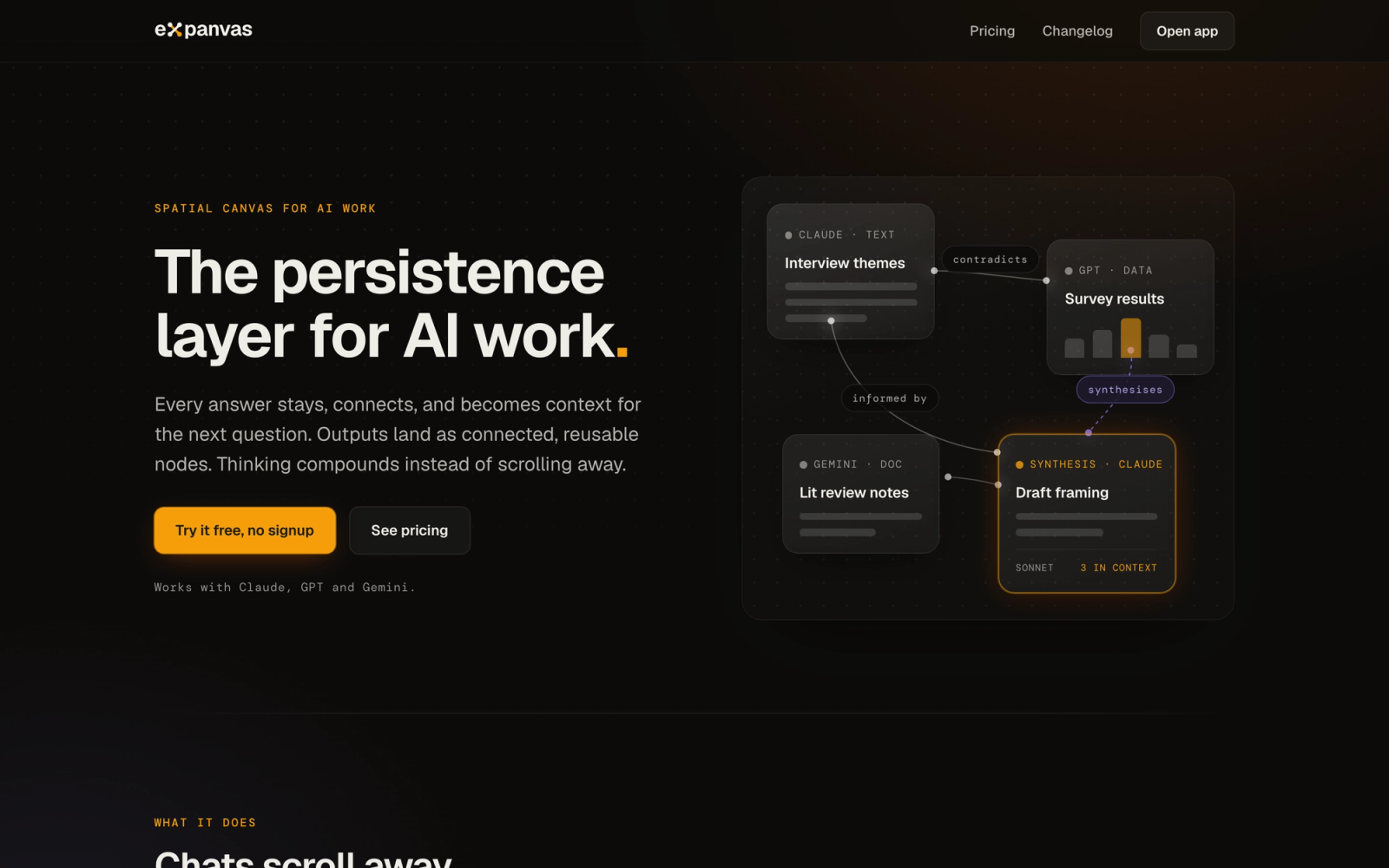
A spatial canvas for AI work, designed, built and shipped solo, because chat is too limited a format. Every answer stays, connects, and becomes context for the next question.
- Client
- Tiger Forest
- Role
- Founder / design and build
- Timeframe
- 2026
- Sector
- AI tooling
- node types
- 15
- models, one canvas
- 3
- Pro, per month
- £12
Chat is too limited
It became obvious when I needed an answer an AI had given me and couldn't find it again in the scroll. I believe the chat format is too limited. An AI chat is a transcript: the useful answers sit in it alongside everything else, and the longer the conversation runs, the further they scroll out of view. To use one again you have to find it, copy it out, and explain it all over again to the next model.
That's not how people work. There's nothing quite like having books, sketch pads and references spread across a desk, where you can open the page of something, point to a picture, pick up a swatch of colour or grab a reference. Expanvas is that experience, brought to digital.
As a designer I wanted to experiment with formats, because I believe we can visualise chat input and output better. I also wanted to build something end to end, not just smaller commits. Expanvas is the result: a spatial canvas for AI work, where every answer stays, connects, and becomes context for the next question.
Nodes, edges, context
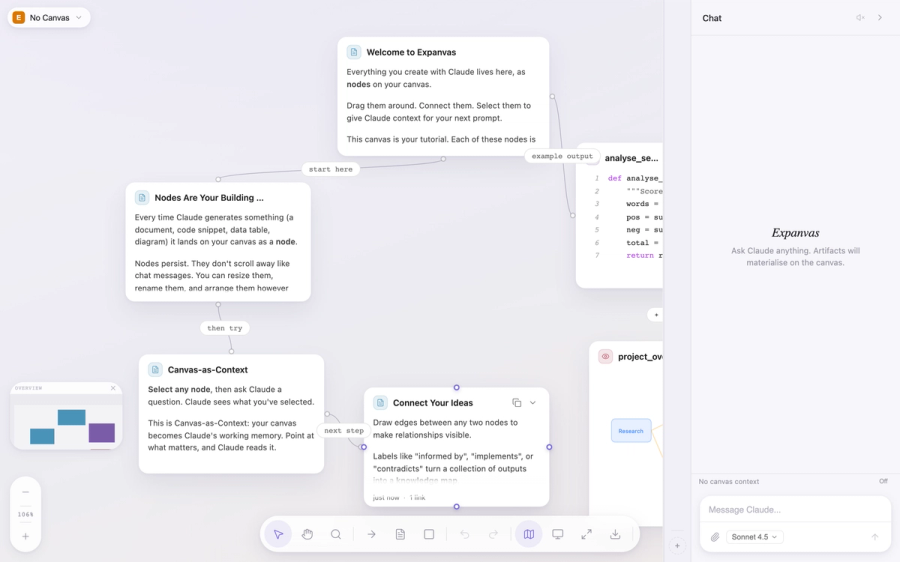
Every AI output lands on an infinite canvas as a persistent card, and it stays where you put it. There are fifteen node types today, covering text, code, data, visuals and documents, and each one can be reused. I didn't arrive at fifteen. We started with fewer and there will be more, because digital work has that many kinds of artefact: chats, documents, decks, PDFs, Mermaid diagrams. The canvas lets you spread them out, see what you've got, and connect them.
Cards connect through labelled relationships rather than plain lines: informed by, contradicts, synthesises. That is about persistence. If you step away from a table covered in notes, or somebody clears it, you lose the mental threads that connected the dots. Labelled edges make that connective tissue permanent and get it out of your head, so the canvas is a map of the thinking rather than a random scattering of digital post-it notes. Related nodes can be grouped into sections and moved as one.
Select any set of nodes and the model reads them. The canvas becomes the conversation's memory, not a transcript to re-explain. Every card carries a footer showing which model made it and when, and it works the same way with Claude, GPT and Gemini, so the work is not tied to one provider.
Shipped end to end
Multi-model, bring your own key, £12 a month. In truth, I was optimising for the build. Each one was a challenge I wanted to overcome and test.
Expanvas is a product a stranger can sign up to and pay for. Guest mode works with no account. The free tier carries 50 messages a month. Pro is £12 a month or £120 a year, with a visible usage meter. Anyone who already has API keys for Anthropic, OpenAI or Google can bring their own: stored encrypted, billed by their provider, and kept out of the free allowance.
Canvases are shareable. A read-only link needs no account to view, editors and viewers can be invited by email, and everyone on a canvas appears with a named, live cursor. A conversation pasted in from claude.ai or ChatGPT materialises as nodes, and any canvas exports as a PNG or a Markdown bundle. Underneath sit rate limiting on the AI proxy, usage metering, an automated test suite and continuous integration on every change.
Who uses it
TBSCG use it for shared strategic projects with several people on one canvas, because the people involved work very differently. A CTO doesn't think like a CFO, who doesn't think like a CEO. What I didn't expect was how immediately they took to it. I wasn't even in the company: I sent it to them while I was interviewing, saying I thought they might like it, and they put it straight into their strategic workshops.
How I built it
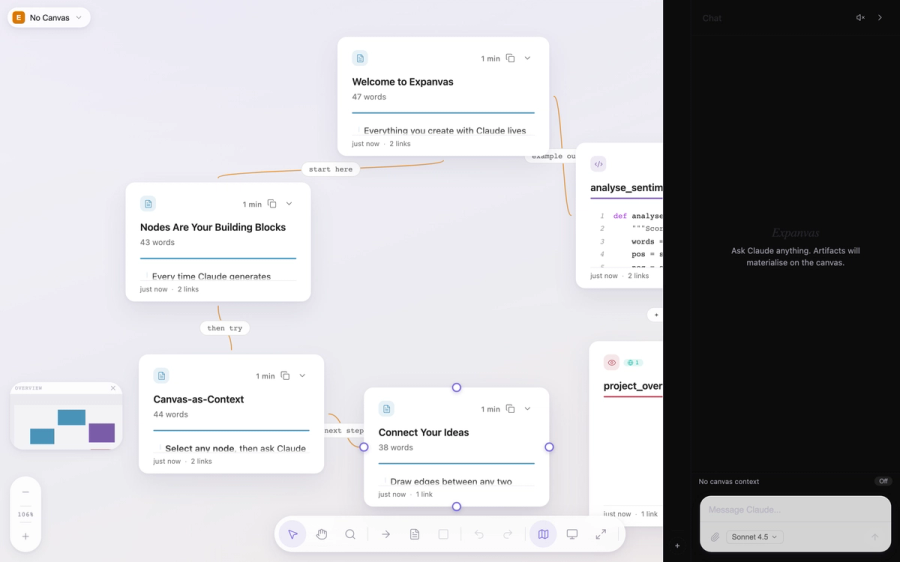
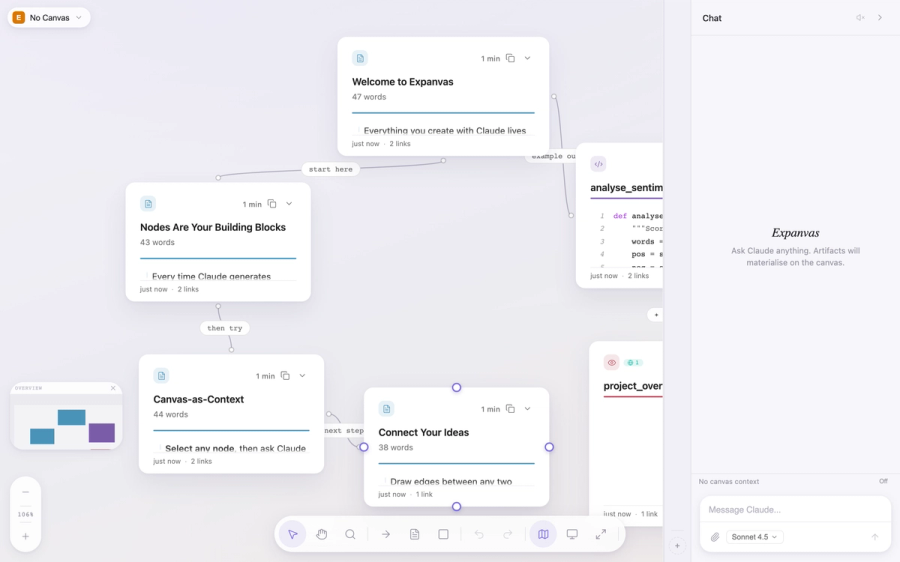
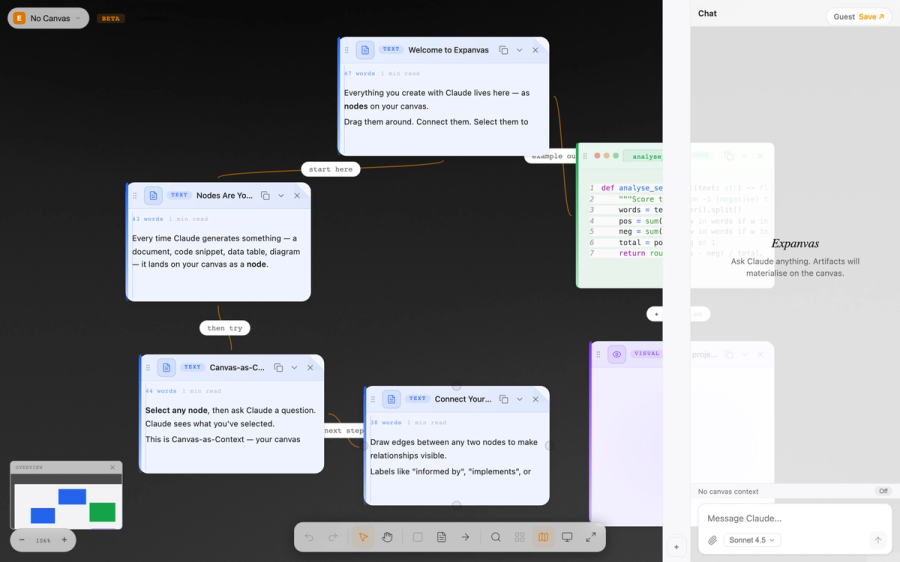
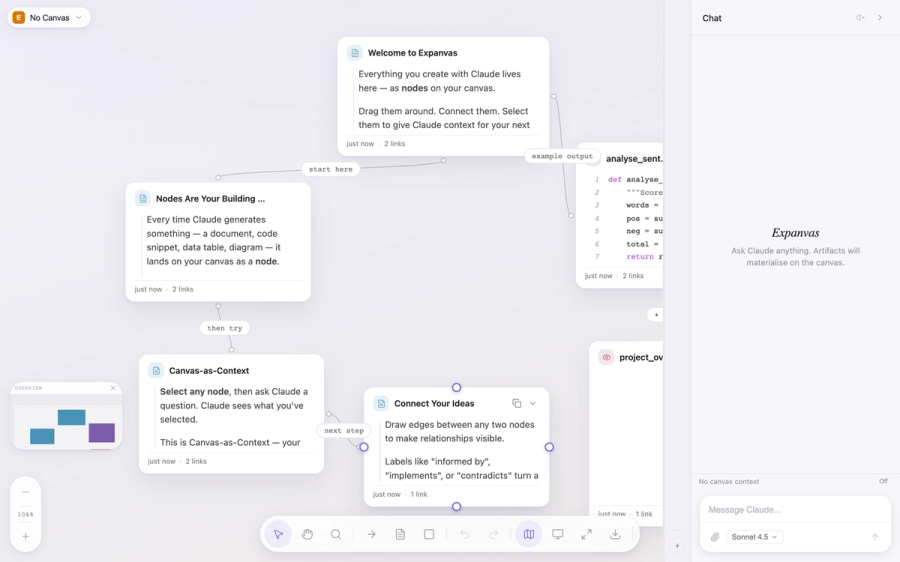
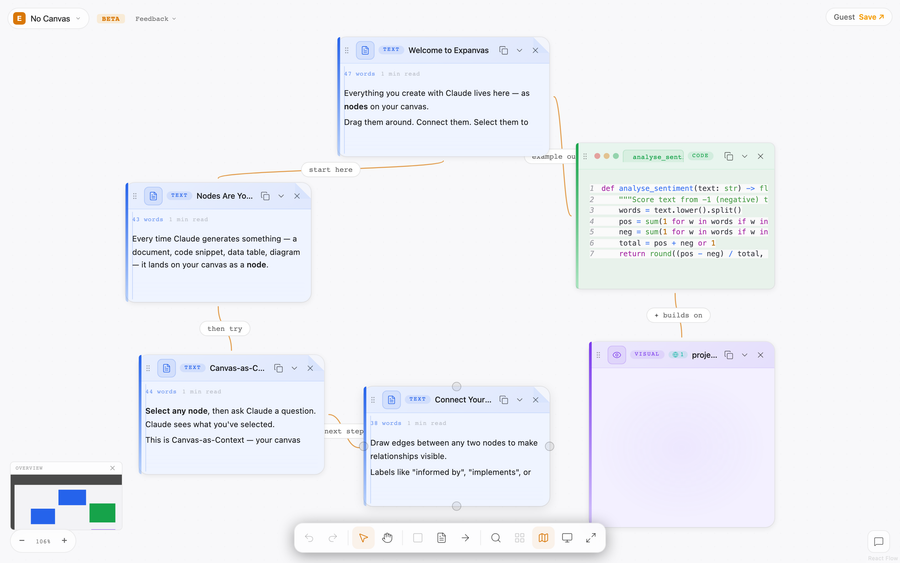
I designed and built Expanvas alone, starting on 21 February 2026. Vibe coding meant the iterations reflect my learning of the process as much as the product. Sometimes I got carried away throwing features at it; other times I pulled myself back and brought a more rigorous product management and product design process to it. An old lecturer of mine called it the scars of your thinking. Most of the interface work between February and July was never deployed, so its only trace is the commit history, and the screenshots here were recovered from it build by build, all on the same Getting Started canvas. The node card went from coloured headers and type chips, to a fixed five-zone structure of badge, title, meta, rule and body, to the Soft Stack foundation in July: scale tokens, a light ground and quieter chrome. A content-first round then gave each card three or four lines of real copy, and the changelog named the target: a surface calmer to spend a day in.
Where it stands
Expanvas is live at expanvas.com, and guest mode needs no signup.
It is a personal project. I pick it up and put it down. It shows that I build these tools end to end, and that I'm thinking about different ways to work with AI, and it is one of a series.
Don’t take my word for it
Expanvas is live. Open it in a browser and ask it something.