mise
hospitality prepped from atoms, every piece swappable, every piece yours

- When
- 2026
An open, agent-native platform for running hospitality. Menus, ordering, payments and loyalty rebuilt as pieces that plug into one core, so operators switch on what they need and walk away whenever.
- Began in July as a neutral rail between a venue's systems and its agents.
- Became a full suite in October, with one core, payments built in and POS optional.
- Rebranded around atoms after the first direction, the pass, was too safe.
- In stealth, with the architecture and identity settled and a spike next.
Nothing talks to anything
I spent years as Head of Product Design at QikServe, across around 26 hospitality products and more than 130 integrations. Suites from Access and StoreKit charge heavily for software that's closed, monolithic and slow to change. Operators can't buy only the pieces they need. And the pieces they do buy don't talk to anyone else's.
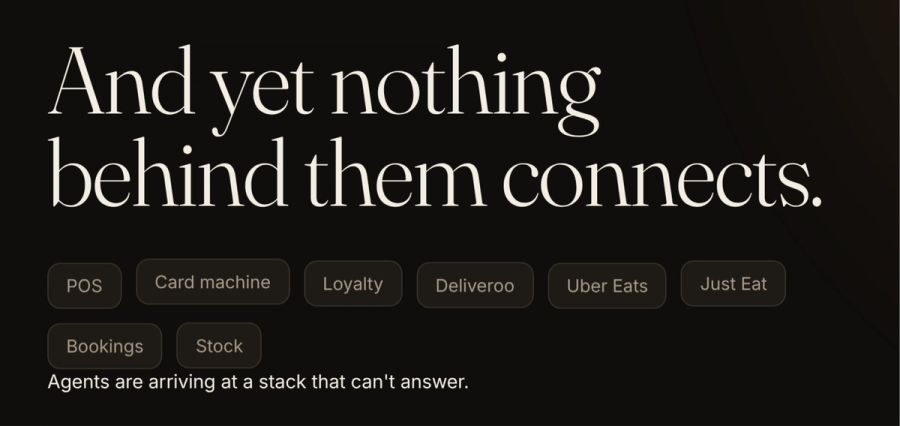
AI changes who gets to fix that. A small team working with agents can now build the connectors, services and screens that once took hundreds of engineers. The result can sell for a fraction of today's prices. So the brief I set myself was to map the whole suite end to end, rebuild it as components anyone can swap, make it easy to self-onboard and put the menu at the centre. The name comes from mise en place, everything prepped and in its place before service.
A rail first
The first version was a cofounder deck in July. It pitched mise as an orchestration layer for the agent era. You'd connect a venue's existing systems once and mise would sit between them and every AI channel, owning nothing and staying out of the flow of money. Four products sat on that rail (telemetry, guest identity, agent discoverability and store data). The deck's whole argument was that nobody had yet built for the corner of the market that's open, AI-native and hospitality-native at the same time.
One core, one front door
In October I set the pitch aside and worked on the architecture of the full suite instead. What made it work was realising a neutral rail and a full suite are the same middleware. They only differ in who builds the modules on top. So the architecture could be designed once, with the go-to-market choice left open for later.
Two of the deck's positions got reversed. Payments now come built in by default so an operator can sign up and start trading straight away, with any provider swappable at no penalty. And where the deck left POS, payments and loyalty alone underneath, the suite builds its own modules while still plugging into everyone else's. I also made the POS optional. If a venue has one, mise connects to it. If not, it trades without one, the way Preoday used to take online orders without a till.
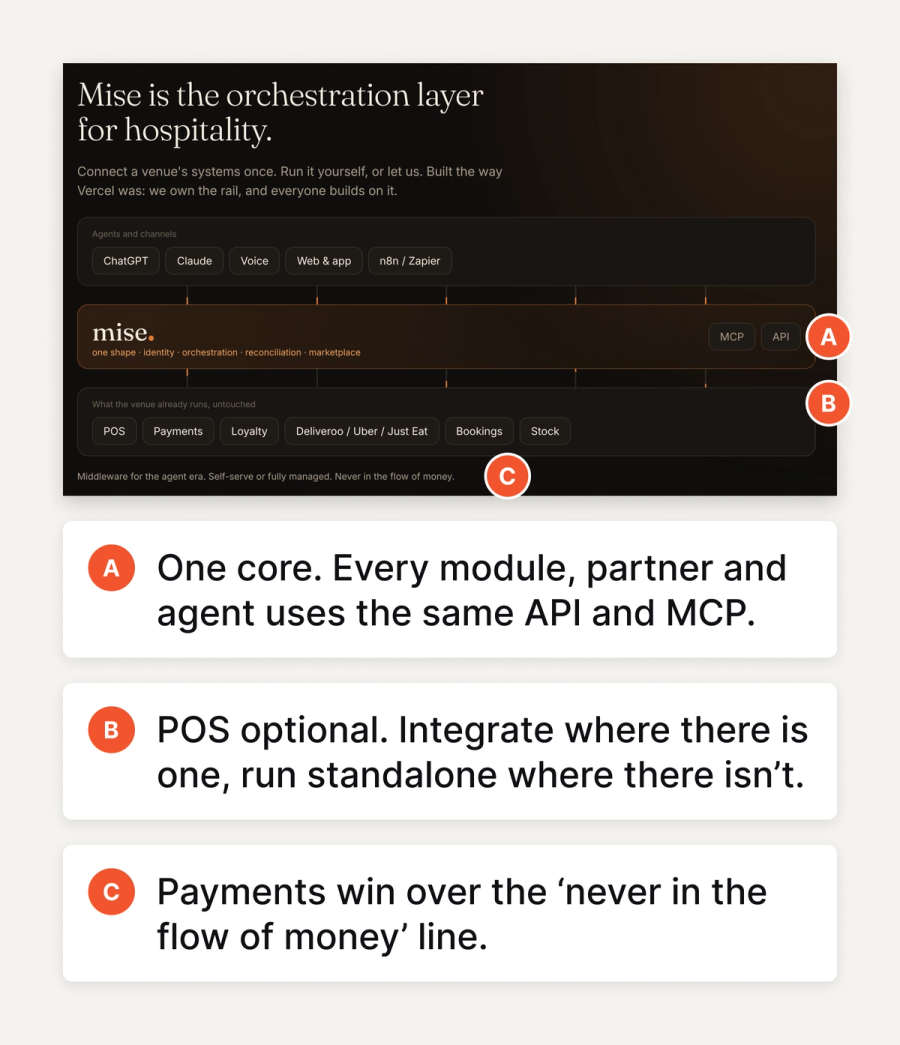
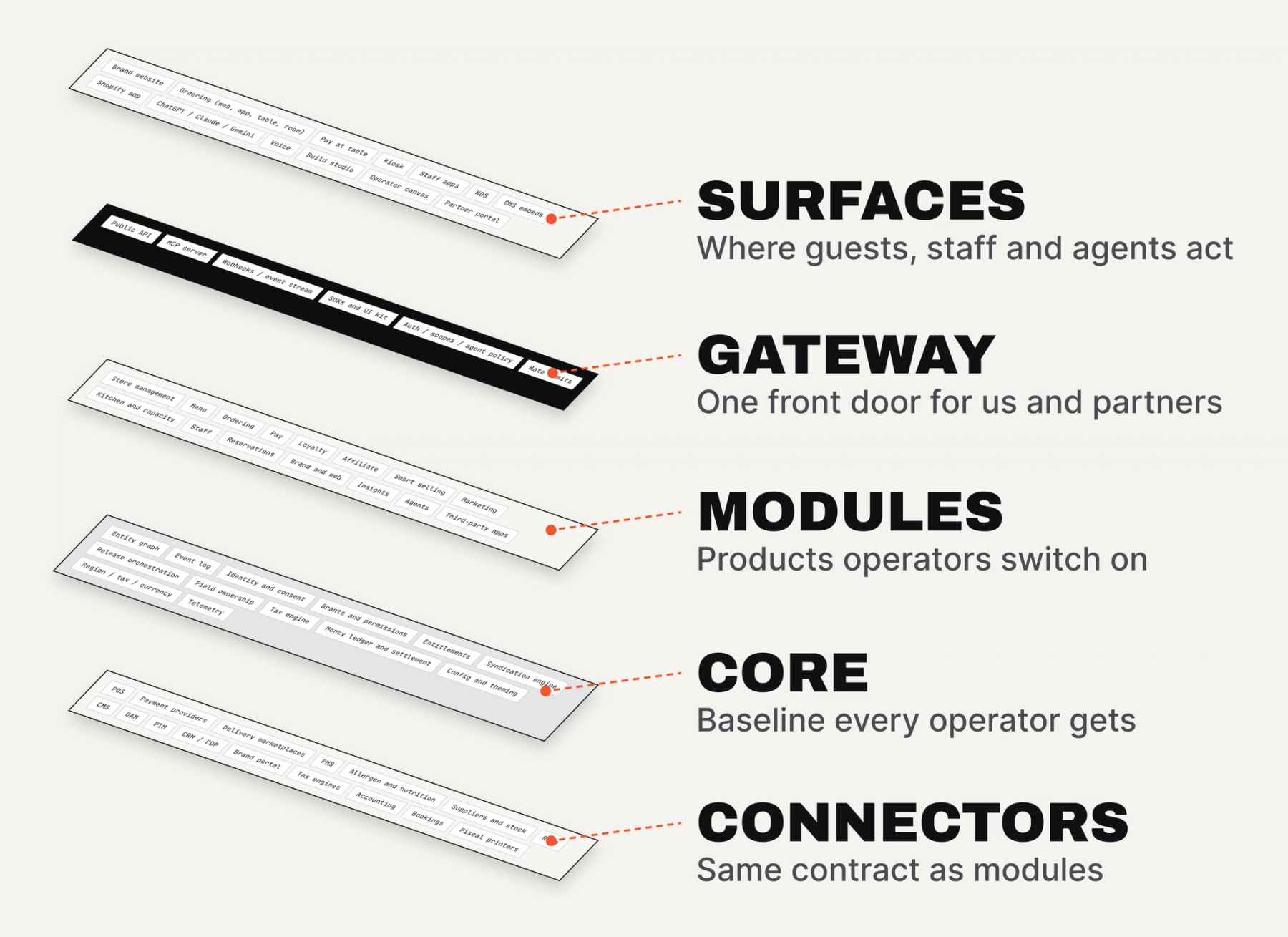
The October architecture, read top to bottom, from where guests and agents act down to the systems mise talks to.
I asked whether to build middleware or wire the modules to each other. The answer that came back was a hub, explained with a wall socket (your kettle and someone else's use the same one). I went with it. Wire modules directly and the integrations grow with the square of the modules. Put a core in the middle and they grow in a straight line. Everything reaches that core through one public API, MCP server and event stream, mise's own modules included, with no special access for anyone. Because any piece can be swapped out, the freedom to leave is part of the structure. I also wanted clear logging from day one, so every change is an event and the log is the record. Audit, telemetry and analytics are just ways of reading it.
Every piece an atom
Underneath, every part of the business is its own piece, from organisation and brand down to kitchen, menu and item, and any piece can run another. I wanted to work from enterprise down while keeping each one independent, so one owner with one shop and a group with a thousand sites use the same building blocks. We went breadth first, eight groups wide, before going deep on anything. With dark kitchens running several brands from one room, and capacity being critical, kitchen became its own entity. A food hall raised a different problem, because the property belongs to one company and each vendor belongs to another. So control can cross between organisations, but only through an explicit grant, and that covers stadiums, airports, hotel outlets and franchises too.
The hotel PMS stayed out. My line on it was "we may pass data back and forth to one, but we are not one", so it became a connector, with room numbers and guest names riding along on the order. Charging to the room is just another payment method. Hospitality tax is awkward enough that it went the other way, into the core. In the UK a hot takeaway is standard-rated while most cold takeaway food is zero-rated, so the same item is taxed differently eaten in and taken away.
Agents run all the way through, from operations to guest ordering. An order always belongs to a guest, with the agent recorded as whoever placed it, so every purchase stays auditable and bounded. A guest's own assistant acts under a mandate they grant, with a spend limit, a payment method, an expiry and limits on what it can see. Loyalty came from POLYTY, a separate concept of mine. Every loyalty platform runs on its own mechanic, whether that's points, credit or discounts, and the mechanic is what locks an operator in. POLYTY starts from the other end. The operator describes the outcome they want, say lunch regulars in twice a week, and AI builds the rules and tests them against past orders. Because the rules export in an open format, the scheme leaves with the operator.
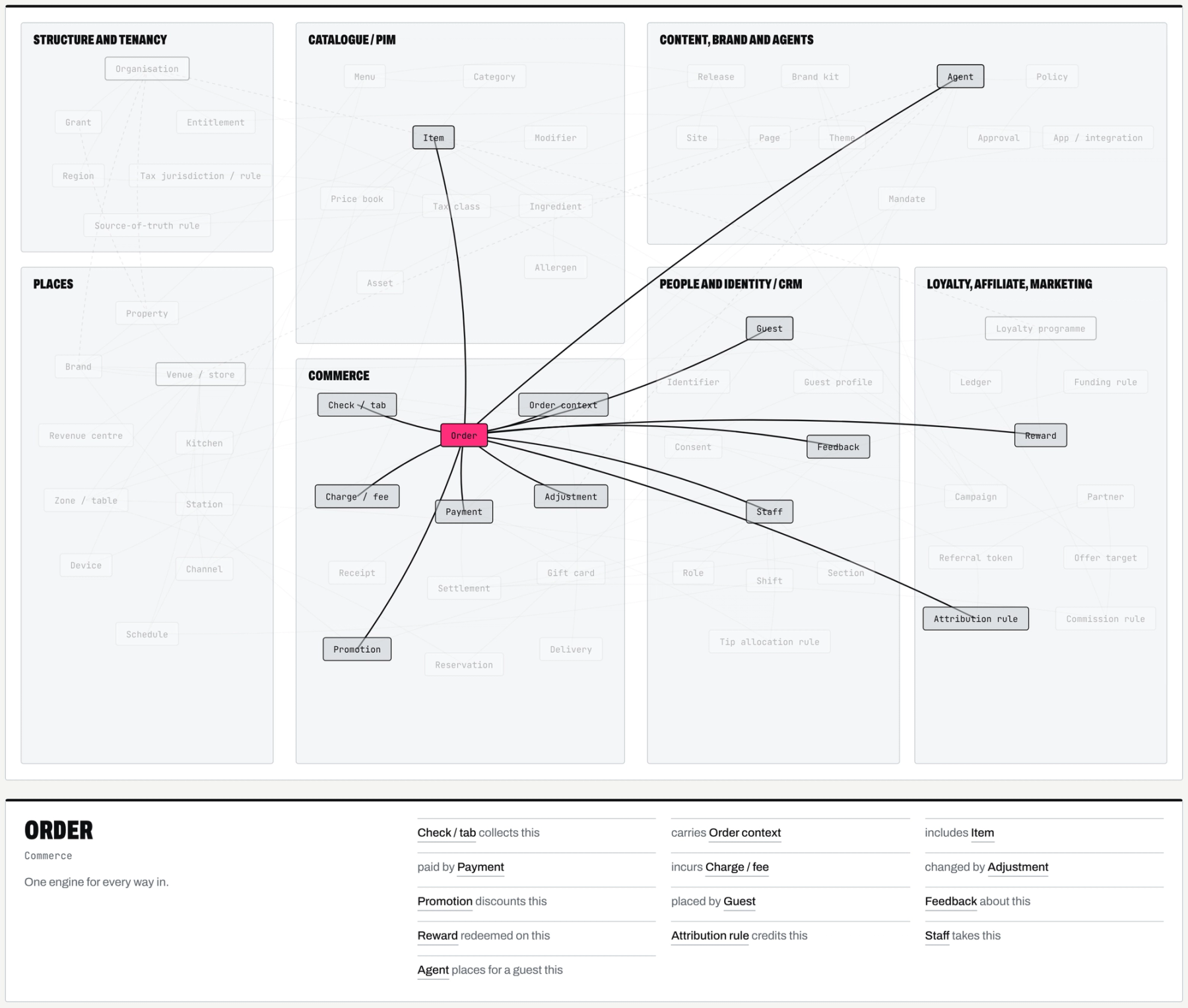
Selected on the entity map, an order is placed by a guest, with any agent placing it on their behalf.
Too safe
The brand brief asked for something trustworthy enough that an operator would hand over payments and allergen data. It also had to be disruptive enough to break from the beige look of the category, and punchier than Toast or StoreKit. I pictured a chef who's both, with the pristine whites and stainless steel cut through by tattoos and a bit of punk. Service had to sit at the centre, because this is an architectural play.
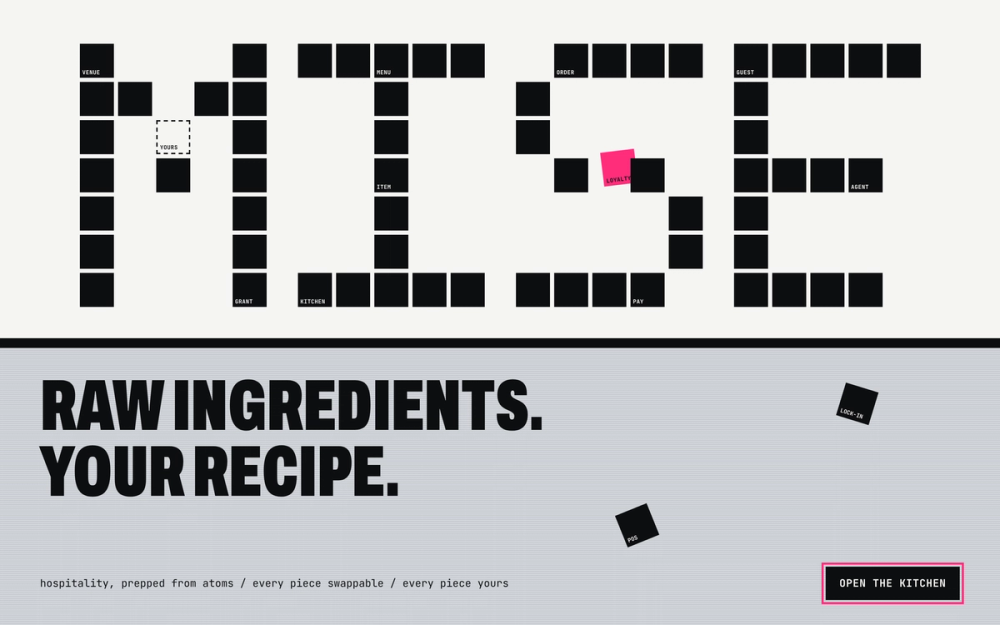
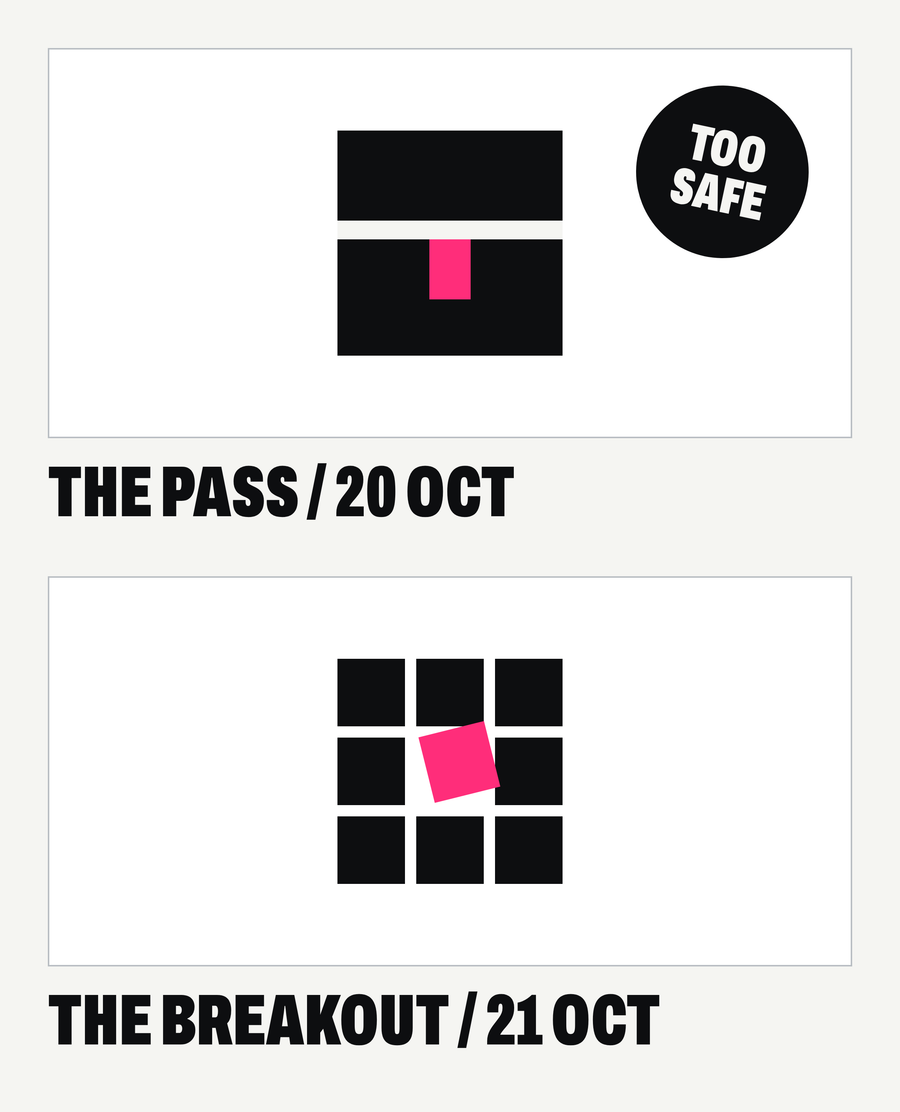
The first direction took that literally. It used the pass, the steel shelf every order crosses, as the mark. My note on the cover was "too safe", with no sense of the atomic build and no sense of disrupting anything. The pass explained how orders get routed. It didn't show the small pieces that can be swapped, removed or replaced with your own, so the identity was rebuilt around atoms. The cover spells MISE in tiles named after real entities, with loyalty knocked out of line, a socket left for third parties, and POS and lock-in fallen off the grid altogether.
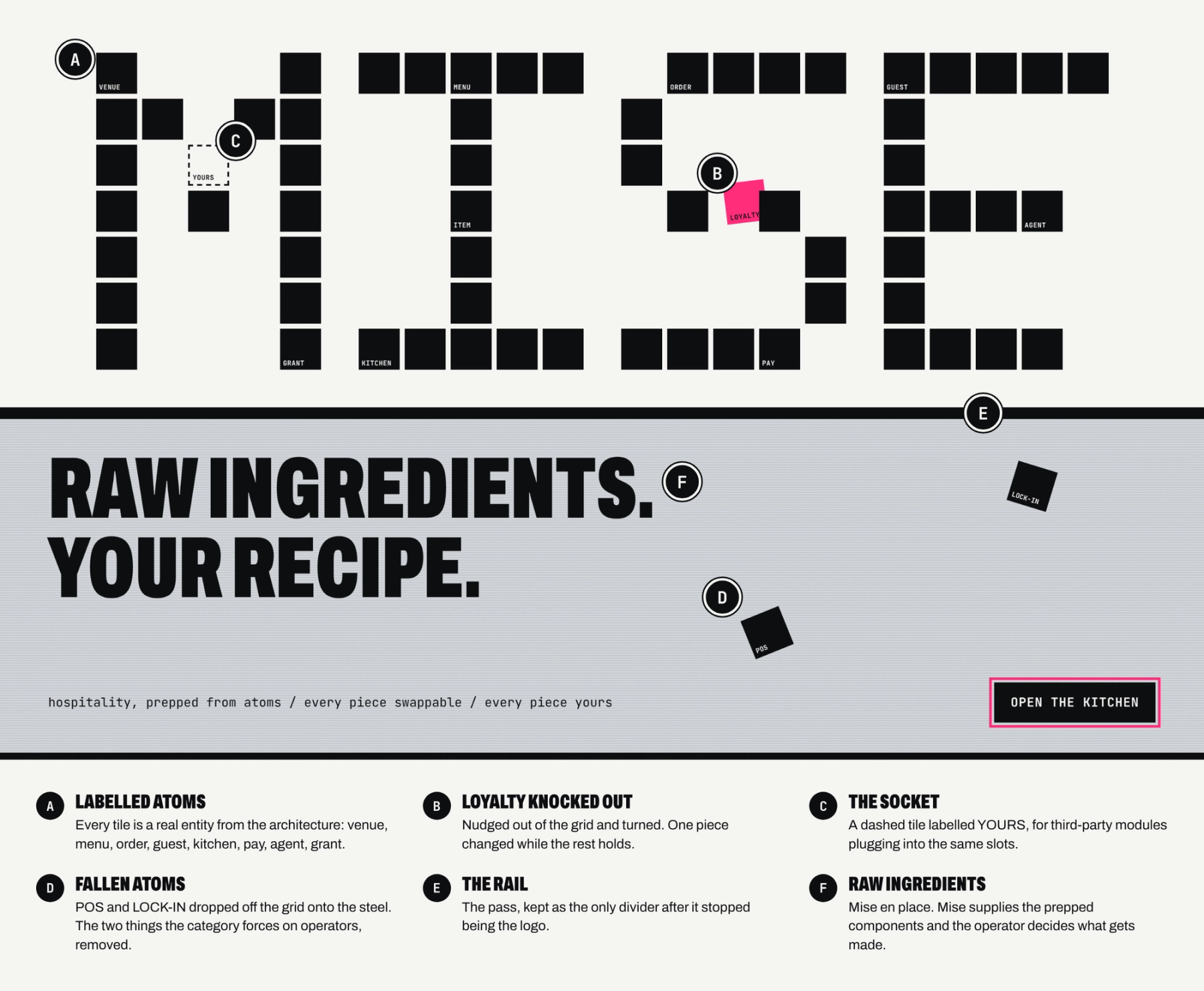
The cover builds MISE from real entities and lets the two things the category forces on operators fall off the grid.
The first headline was "Hospitality, rebuilt from atoms." I thought the better idea was hiding in the name, since atoms read naturally as ingredients. It became "Raw ingredients. Your recipe." The rule-breaking is fenced off, too. Allergens, payment and checkout stay in ink and linen with no pink, no tilt and no blackletter, which mirrors the locked-but-stylable components in the architecture. People trust an allergen warning or a payment screen when it looks calm and certain.
- Photography via UnsplashSebastian Coman / Julia Vivcharyk / Rosalie Gdy / Zoren Tan / Izzedine Elfatih
- Concept imageryMise, generated in Figma Weave
Where it stands
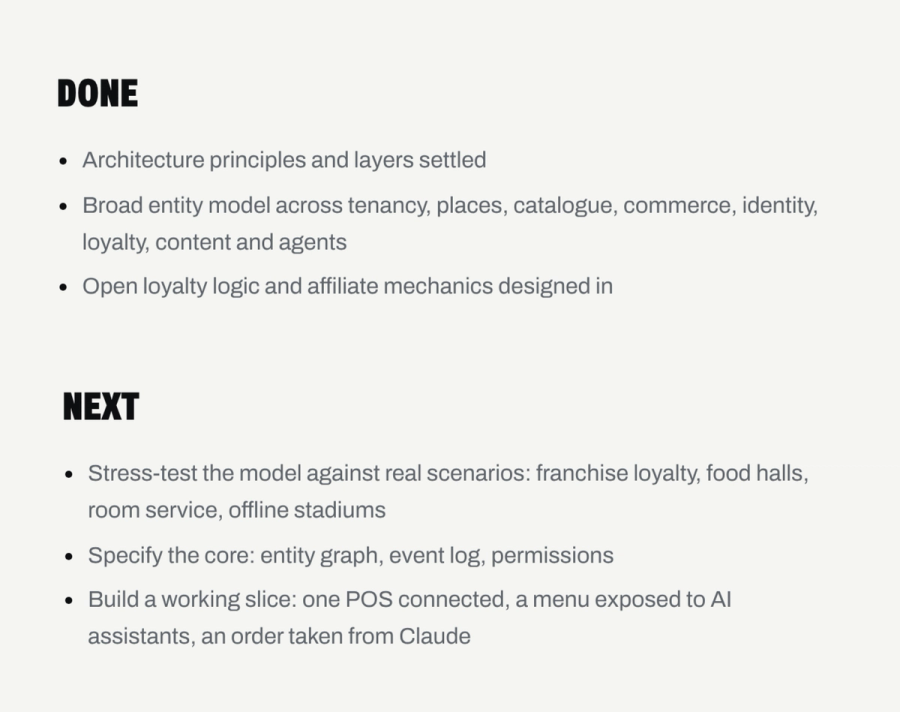
For now mise is in stealth. The private site isn't indexed, operator conversations are paused and the waitlist is scrapped. The architecture and the identity are settled, with around twenty decisions logged along the way. Next comes a stress test against real scenarios, from franchise loyalty and food hall settlement to a guest's assistant ordering with a nut allergy and a stadium losing its connection. After that come specs for the core and then a working spike, which is me and agents for four to eight weeks. Agentic teams compress connectors, admin screens and tests a great deal. Payment correctness, offline sync, certification and sales barely move, so the discipline that matters most is keeping the first wedge small.